The Atomic Ending of An Era The Atomic Ending of An Era

  • Home
  • Manhattan Project and Pearl Harbor Attack
  • Japan Surrenders


The Manhattan Project

Timeline: 

On August 2, 1939-

Albert Einstein writes President Franklin D. Roosevelt a letter, in which he alerts the President of the importance of research on chain reactions and the possibility that research might lead to developing of the Atomic Bombs.

June 28, 1941-

Vannevar Bush is named head of the Office of scientific Research and Development. James B. Conant replaces Bush at the National Defense Research Committee, which becomes an advisory body to the Office of Scientific Research and Development. 

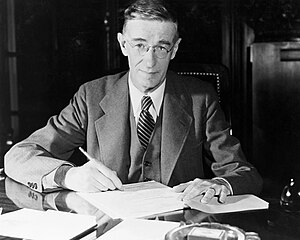
A man in a suit poses sitting at a desk, pen in hand. Papers and an ash tray are on the desk.


March 9,1942

Bush gives Roosevelt an optimistic report on the possibility of producing a bomb.

June 17 1943

President Roosevelt approves the S-1 Executive Committee recommendation to proceed to the pilot plant stage and instructs that plant construction be the responsibility of the Army. The Office of Scientific Research and Development continues to direct nuclear research, while the Army delegates the task of plant construction to the Corps of Engineers.

December 28, 1942

Roosevelt approves detailed plans for building production facilities and producing atomic weapons.


March 1943

Researchers begin arriving at Los Alamos.

April 1943

Bomb design work begins at Los Alamos.

March 1944

Bomb models are tested at Los Alamos.

Summer 1944-Spring 1945

The Manhattan Project's chances for success advance from doubtful to probable as Oak Ridge and Hanford produce increasing amounts of fissionable material, and Los Alamos makes progress in chemistry, metallurgy, and weapon design.

June 1945

Scientists at the Metallurgical Laboratory issue the Franck Report, advocating international control of atomic research and proposing a demonstration of the atomic bomb prior to its combat use.

July 16, 1945

Los Alamos scientists successfully test a plutonium implosion bomb in the Trinity shot at Alamogordo, New Mexico.

 August 15, 1947

The Manhattan Engineer District is abolished.

December 31, 1947

The National Defense Research Committee and the Office of Scientific Research and Development are abolished. Their functions are transferred to the Department of Defense

Articles: 
  1. ‘A Very Pleasant Way To Die’: Radiation Effects and the Decision to use the Atomic Bomb against Japan: This article examines a related question that has received surprisingly little scholarly attention: what did American scientists and policy makers know about radiation effects prior to the use of the bomb? In making the decision, did American leaders understand that the atomic bombs used against Extensive research carried out by Manhattan Project scientists and physicians during World War II, including both human and animal experiments, greatly expanded knowledge of the biological effects of ionizing radiation. The high-level American leaders who made the final decisions about the bomb, including President Harry S. Truman, Secretary of State James F. Byrnes, and Secretary of War Henry L. Stimson, were never informed that the weapon would continue to sicken and kill its victims long after use. For all of the outstanding technical successes of the Manhattan Project, the policy of wartime compartmentalization and postwar denial with respect to radiation effects ultimately served neither American leaders nor the many victims of the bomb in Japan.
A Very Pleasant Way to Die.pdf A Very Pleasant Way to Die.pdf
Size : 223.91 Kb
Type : pdf

Pearl Harbor Attack

Articles:
  1. Hallowed Ground.. A date that will live in infamy: The article discusses the history of Japan's bombing of the Pearl Harbor, the American naval base in Oahu, Hawaii on December 7, 1941. A Japanese midget submarine that was attempting to enter the Pearl Harbor was fired by the destroyer USS Ward. Japanese torpedoes and bombs destroyed the U.S. Pacific Fleet, including the battleships Oklahoma and West Virginia. The remains of 34,000 Americans who died during the attack were located at the National Memorial Cemetery of the Pacific in Oahu.
http://lib.ollusa.edu:2511/ehost/pdfviewer/pdfviewer?sid=47824b6a-1000-4404-bf38-45f73e22ed36%40sessionmgr198&vid=18&hid=128


Make a Free Website with Yola.