Japan's Surrender
•Ending of an Era•
by Alberto Villalobos/Anze Kos/Corrigan Moran/Darion Brown
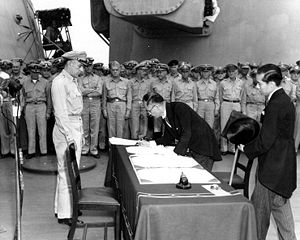
This History exhibit will provide you, the viewer, with timeline information, pictures, and articles of the events that led to the Surrender of Japan during World War II
RESOURCES:1. Hotta, Eri. Japan 1941: Countdown to Infamy. New York: Vintage Books, 2013. A Japanese-oriented history based around the simple question: “Why did Japan attack Pearl Harbor?” The answers of which depict the militaristic culture willingly leaping into a probably unwinnable war. Passages will be used to reinforce the Pearl Harbor segment of our digital exhibit. From the Sueltenfuss Library. 2. Takaki, Ronald T. Hiroshima: Why America Dropped the Atomic Bomb. Boston: Little, Brown, and, 1995. A history of the bombing of Hiroshima, centered around the question: “Why did America bomb Hiroshima?” The book draws from many sources, including even Truman’s private letters. Passages will be used from this book on the Manhattan Project, Atomic Bombing, and Japan’s Surrender portions of the digital exhibit. From the Sueltenfuss Library. 3. Bird, Kai, and Lawrence Lifschultz. Hiroshima's Shadow. Stony Creek, CT: Pamphleteer's Press, 1998. A collection of essays debating the use of atomic weapons, ranging from historical censorship to early criticism. Passages from these essays will be used in the Manhattan Project, Atomic Bombing, and Japan’s Surrender regions of our digital exhibit. From the Sueltenfuss Library. 4. Yamashita, Samuel Hideo. Leaves from an Autumn of Emergencies: Selections from the Wartime Diaries of Ordinary Japanese. Honolulu: University of Hawaii Press, 2005. A collection of diary entries by eight Japanese citizens from the 1940’s provides everyday insight into cultures of Japan being increasingly pressed upon by wartime tragedy. Passages will be used in the timeline to provide emphasis on the individual present in history. From the Sueltenfuss Library. 5. Unforgettable Fire: Pictures Drawn by Atomic Bomb Survivors. New York, NY: Pantheon Books, 1981. A collection of drawings, paintings, and works of art of varying expertise depicting the atomic bombing of Hiroshima. August 6, 1945 as it was singed into the memories of those who survived long enough to illustrate it.Various scans of pieces within will be available in the aftermath region of our exhibit. From the Sueltenfuss Library. 6. The Decision to use the Atomic Bomb: the article presents the text of February 1947 comments by the United States Secretary of War Henry L. Stimson regarding the decision of the American government to use the atomic bomb against Japan during World War II. Stimson describes his role on a committee on the use and development of atomic energy, appointed by President Franklin D. Roosevelt in 1941. Roosevelt pursued a policy of quick development of an atomic weapon, based on the belief that Germany was developing atomic weapons. The process of development and testing of the atomic bomb is described. Stimson looks at the decision to employ the atomic bomb against the Japanese cities of Hiroshima and Nagasaki, under U.S. President Harry S. Truman in 1945. Stimson discusses the projected political impact of the atomic bombing of Japan, and discusses his opinion of the plan. The article states that the U.S. was successful in its use of the atomic bomb to force Japan's surrender in World War II. http://web.a.ebscohost.com/ehost/detail/detail?vid=4&sid=59860feb-6a09-4f0a-8d10-0986e0484314%40sessionmgr4005&hid=4207&bdata=JnNpdGU9ZWhvc3QtbGl2ZQ%3d%3d#db=a9h&AN=21212319 Stimson, Henry L. “The decision to use the atomic bomb.” Decision To Use The Atomic Bomb(January 21, 2009): 1. Academic Search Complete, EBSCOhost(accessed October 23, 2014) 7. Why Japan Surrendered: The article investigates the reasons for the surrender of Japan in World War Two. Argument for the significance of military vulnerability instead of civilian vulnerability; Events that generated the vulnerability; Coercive strategies of Allied forces; Responses of Japanese leaders; Analysis of four alternative explanations. http://web.a.ebscohost.com/ehost/pdfviewer/pdfviewer?sid=59860feb-6a09-4f0a-8d10-0986e0484314%40sessionmgr4005&vid=7&hid=4207 Pape, Robert A. “Why Japan surrendered.” International Security 18, no. 2 (Fall93 1993): 154. Academic Search Complete, EBSCOhost (accessed October 23, 2014) 8. Military Wisdom and Nuclear Weapons: The article focuses on the reasons behind Japan's surrender in the World War II due to a number of events that took place in the country from August 6-9, 1945. It informs that following bombing on August 6 in Hiroshima, the Japanese government had not decided to surrender. It states that the decision to surrender was taken on August 9, the day on which Nagasaki was bombarded due to the Soviet Union's declaration for war on August 8. http://web.a.ebscohost.com/ehost/pdfviewer/pdfviewer?sid=59860feb-6a09-4f0a-8d10-0986e0484314%40sessionmgr4005&vid=10&hid=4207 Wilson, Ward. “Military Wisdom and Nuclear Weapons.” JFQ. Joint Force Quarterly no. 68 (2013 First Quarter 2013): 18-24. Academic Search Complete, EBSCOhost (accessed October 23, 2014) 9. ‘A Very Pleasant Way To Die’: Radiation Effects and the Decision to use the Atomic Bomb against Japan: This article examines a related question that has received surprisingly little scholarly attention: what did American scientists and policy makers know about radiation effects prior to the use of the bomb? In making the decision, did American leaders understand that the atomic bombs used against Extensive research carried out by Manhattan Project scientists and physicians during World War II, including both human and animal experiments, greatly expanded knowledge of the biological effects of ionizing radiation. The high-level American leaders who made the final decisions about the bomb, including President Harry S. Truman, Secretary of State James F. Byrnes, and Secretary of War Henry L. Stimson, were never informed that the weapon would continue to sicken and kill its victims long after use. For all of the outstanding technical successes of the Manhattan Project, the policy of wartime compartmentalization and postwar denial with respect to radiation effects ultimately served neither American leaders nor the many victims of the bomb in Japan. http://web.a.ebscohost.com/ehost/pdfviewer/pdfviewer?sid=59860feb-6a09-4f0a-8d10-0986e0484314%40sessionmgr4005&vid=17&hid=4207 Malloy, Sean L. “A Very Pleasant Way to Die’. Radiation Effects and the Decision to Use the Atomic Bomb against Japan. “Diplomatic History36, no. 3 (June 2012): 515-545. Academic Search Complete. EBSCOhost (accessed October 23, 2014) 10. Hallowed Ground.. A date that will live in infamy: The article discusses the history of Japan's bombing of the Pearl Harbor, the American naval base in Oahu, Hawaii on December 7, 1941. A Japanese midget submarine that was attempting to enter the Pearl Harbor was fired by the destroyer USS Ward. Japanese torpedoes and bombs destroyed the U.S. Pacific Fleet, including the battleships Oklahoma and West Virginia. The remains of 34,000 Americans who died during the attack were located at the National Memorial Cemetery of the Pacific in Oahu. http://web.b.ebscohost.com/ehost/pdfviewer/pdfviewer?sid=a7e485f9-62f3-48d8-bf4f-41cba43d11cd%40sessionmgr111&vid=4&hid=125 Dudley, Wade G. “Hallowed Ground…a date which will live infamy.” Military History28, no. 5 (January 2012): 32-36. Academic Search Complete, EBSCOhost(accessed October 23, 2014) |
